
The Digital Sea, Swallowed

Three years ago, AI arrived like an occasional seashell washing up on the shore. My nephews and husband were using ChatGPT to make rap songs and bawdy limericks. More fatigued than amused, I wasn’t concerned because this little app couldn’t even count to 50.
Last month on a Southern California beach, after a tumultuous stretch of AI headlines, I realized we were past the point of no return. Over that salt-misted day until sunset, a parable took shape: a daytime fever dream, an echo of a childhood book* that still leaves me wide-eyed.
The tide goes in and the tide goes out, and when the full moon rises silver and swollen, the water pulls back to reveal all the creatures living beneath the surface: the crawling that nourish, the hidden that can sting, the luminous pearls and shells that people crave for baubles, treasures briefly revealed. Tidepoolers gather them and inspect them, perhaps pausing too long to turn them over in their hands, until the returning tide drenches them as they wade through the cove, soaked and shaking off their carelessness.
Like their forebearers who lived near the shore, they build their homes on cliffs, and when the tide pulls back like an avalanche about to descend, they move from the shore without incident. But an amnesiac generation builds hotels along the shore and their way of life depends on tourist dollars. An earthquake of magnitude predating recorded history shakes the opposite shore without warning to the tourists who hear no sirens but a fullness of silence.
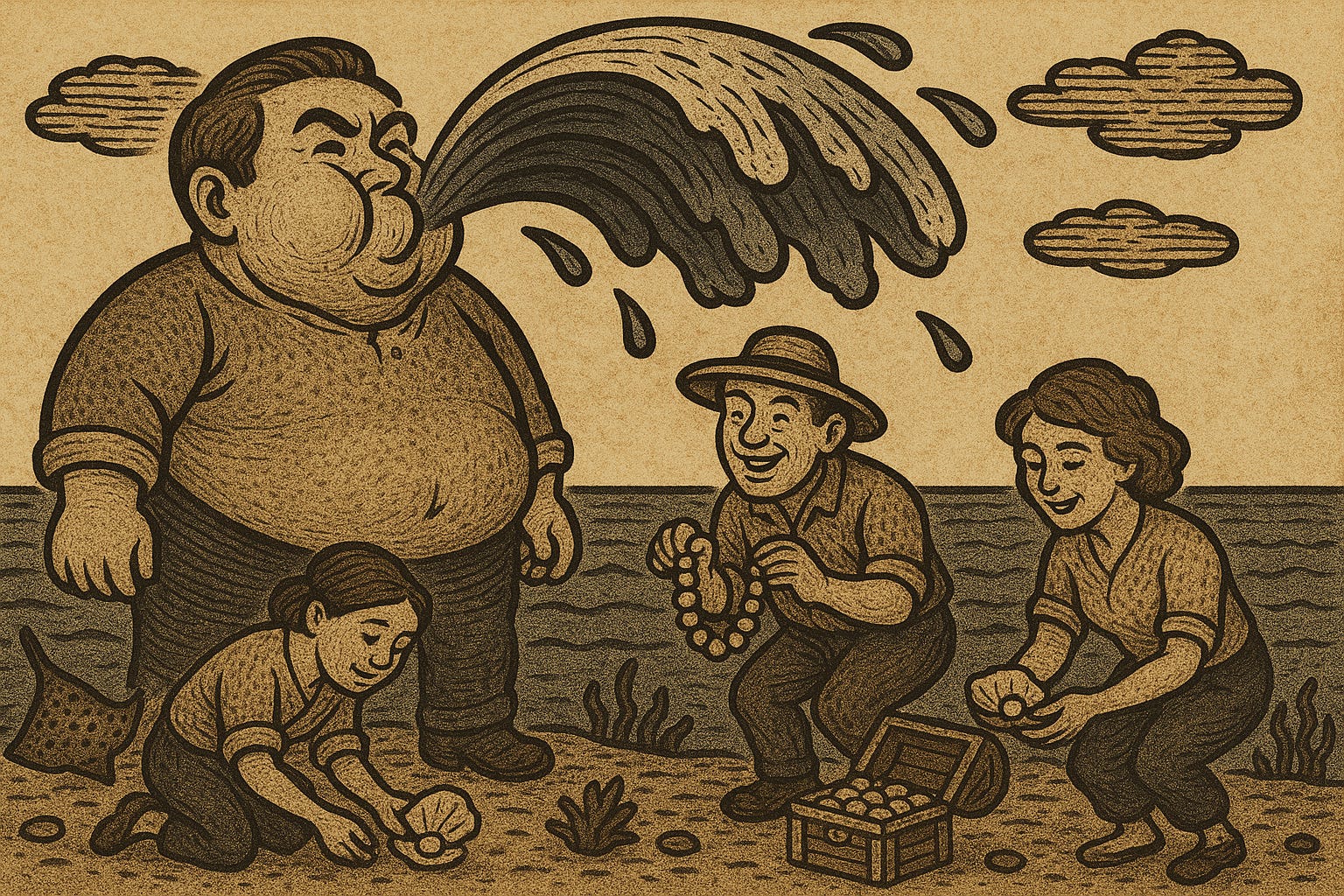
They turn to see an old Chinese man swallowing the sea. Their awe paralyzes their feet as sand is pulled away, stinging as it strips them, leaving them on mounds that collapse. They move close to the water’s glistening edge, unaware of the crescendo that will bury them like the Chinese brothers who waded too far out when the old man gasped for air.
The town historian reminds that the man does not just swallow the sea but that his cheeks bulge with an ocean he can no longer hold. For scientists, alarm sets in as they recalled geological calcifications beyond their cliffs predating recorded history. Together, they scream to the shore, waving their arms at those transfixed. But the tourists remain, as grimaces fall on the townfolk who squirmed at the cost of installing warning networks based on foolish scientists and folklore.
Bodies wash up on distant shores where languages do not blend and lands do not meet.
For months, watermarks remain on the town and survivors move from the shore, always keeping elevation in sight, always scanning the seam where sky meets water. Townspeople along all shores and inland give freely to build sentinel towers and neural network alert systems. Now steel and stone cannot fade, the earth’s tremors are recorded and buoys measure the pulse of distant waves, recorded for all time.
The world vows that the loss of humanity will not recur like the tide itself.
Infrastructure persists like geological memory, but memories still fade over news cycles. Warnings are disruptive, highways close, and tones are lowered to reflect the public’s tolerance for inconvenience. Tourism returns as hotels open, newcomers move to the shore, and vigilance lessens. But most map their distance to the nearest tower when the tone sounds.
And indeed, a massive volcano explodes in the middle of the ocean, faults creak, and all shores coordinate as scientists calculate the tsunami’s arrival time with desperate precision. This time, as the ocean pulls back from coastline, few lives are lost, except those too young to know otherwise, those made vulnerable by age who cannot run fast, and those who forgot their phone or watch that day.
I wrestled that day with whether I am the tourist transfixed by treasure, or the townfolk squirming at the cost, or the one screaming warnings from the shore.
But I’m not alone in this confusion. How many of us are still travelers who haven’t heard the warnings, fascinated by the beauty the exposed sands reveal? The iridescent shells and starfish, the wrecks and whale bones of authors, artists, and inventors are like riches to gather for our business. The newbies, exuberant in our ability to vibe code, walk out curiously toward the seabed, pausing too long to turn treasures over in their hands. The whiz kid “bros” in Silicon Valley choose to stay out longer anyway, confident they can run faster than any tide, chasing what glitters in the sudden sunlight: a trip to Mars, flying cars, fortunes built on automation. For the majority of us, our way of life now depends on this. We are fetching shells without understanding the dangers of “fetching” and “sending”, the distance the wind travels over open water to build the wave that could destroy us.
Our peril is not the vertical ocean of model collapse or autonomous weapons roaring in some distant future. It is the rising tide that we repeatedly sandbag until we cannot ignore it. The ground shifts beneath us, sand pulled away grain by grain. We’ve already seen casualties: artists and actors whose work and voice likeness trained models without consent, writers replaced by algorithms, quiet losses appearing on distant shores.
Some of us are screaming warnings, while some grimace and squirm about the cost of building safeguards. Our businesses depend on the speed, the efficiency, the economic advantage. Even more, some want to own the digital ocean and have us pay them to mine it.
The old man is holding the sea in his mouth, and we can all see his cheeks beginning to tremble.
We need literal sandboxes to experiment. Sirens that flag implausible statistics masquerading as plausible. Intermittent pauses through outputs, like nightly beach closings to clear bonfires and debris. While beachcombing is a pleasure that we don’t want to end, more importantly, our data seas hold patterns that can save lives, improve lives, and bring joy for all, not just a trip to Mars for some.
We need sea captains to navigate deeper waters, researchers building proper rigs. The uncomfortable truth is that many stepped up before we even realized that we needed them. As of now, our captains include AI safety researchers and open source communities. We are writing regulation after captains left port. Right now, the people with the deepest resources and the fastest vessels are choosing themselves, racing to drill while claiming they’ll be the responsible ones.
This is our sea. No one owns it. We must chaperone our rig operators and ensure they protect what belongs to all of us.
The ocean always returns. It may not be with the violence of robots taking over, but with the persistence of rising tides we ignore.
Even with firm warnings, there will always be casualties among those who live casually. For the rest of us, we can walk the shore, study the tidepools, benefit from what the tide reveals. But we pay attention now. We preserve what matters. We keep towers in sight and run when sirens sound.
The old man cannot hold the sea forever.
*The Five Chinese Brothers by Claire Huchet Bishop and Kurt Wiese, along with several ancient stories including the fisherman Urashima Tarō who lost centuries underwater, and Yu the Great who channeled floods with mountains rather than damming them.
Excellent analysis; it makes me wonder if the "amnesiac generation" building along the shore are just legacy companie waiting for a tech-driven tide to sweep them away.